

 English
 日本語
日本語 Español


Industry News

Home / Media Centre / Industry News / Memory Foam Mattress on a Regular Bed Frame: What Works and What Fails
Product Category
NEW Category
Contact us
Memory Foam Mattress on a Regular Bed Frame: What Works and What Fails
Mattress Foundations
Can You Use a Memory Foam Mattress on a Regular Bed Frame?
Yes, in most cases — but only if the frame passes three measurable checks. Here is how to test the one you already own in about ten minutes, and what to do when it falls short.
Unboxing a queen memory foam mattress takes about ten minutes. Watching it slowly deform on a frame that was never built for it takes a good deal longer. The question arrives from retailers, buyers and first-time foam owners almost every week, and the honest answer is more specific than most people expect.
A memory foam mattress can go on a regular bed frame — a metal frame with slats, a wooden slat base, a platform bed — and it does not need a box spring. What it does need is a support surface that stays flat and evenly spaced, and a frame that carries the loaded weight without bending. Foam conforms to whatever sits beneath it. If the base is flat and rigid, the mattress performs as designed for years. If the base gaps or flexes, the foam records that shape and keeps it.
Memory foam does not push back against a weak base. It absorbs the shape of that weakness and holds it.
The Short Answer: Yes, With Three Conditions
Before measuring anything else, run the frame through three checks. Pass all three and an all-foam memory mattress can sit directly on the frame, with no box spring, no bunkie board and no plywood sheet in between.
- Gap rule. Slats or other support surfaces should sit no more than 2.75 to 3 inches (7 to 7.5 cm) apart. Wider gaps let the foam push down between them, and slow-recovery foam remembers that shape.
- Center support rule. Queen and king frames need a center rail with at least one leg that reaches the floor. A center rail that floats above the ground still flexes under load.
- Load rule. Add the mattress to the sleepers. A queen memory foam mattress commonly weighs 60 to 90 pounds, and two adults add roughly 300 to 350 pounds. A frame rated for 600 pounds handles a queen comfortably; a king wants 800 or more.
There is a paperwork condition as well. Most mattress warranties require a firm, non-flexing foundation, and inspectors ask about the base before approving a claim. A mattress that sags on a flexible frame is generally treated as a support problem rather than a manufacturing defect — which means the base can decide whether a warranty is honoured or refused.
What People Actually Mean by "Regular Bed Frame"
The phrase covers at least six different bases sold today, and they behave very differently once an all-foam mattress is placed on top.
| Base type | Behaviour under memory foam | What to verify |
|---|---|---|
| Metal frame with slats | Good, provided the slats are close and rigid | Slat gaps under 3 inches; center rail on queen and king; tight bolts |
| Wooden slat bed | Good support with natural airflow | Slats at least 2.5 inches wide, gaps under 3 inches, no bowing at the middle |
| Platform bed with solid deck | The most forgiving base | Add vent holes or a breathable underlay to prevent trapped moisture |
| Panel bed with spring box spring | Risky, because the surface compresses | Replace the box spring with a slatted or solid foundation, or add a bunkie board |
| Adjustable base | Works well; foam is the most articulation-friendly mattress type | Check the weight rating and that the deck stays continuous when raised |
| Floor | Acceptable, but poor airflow | Use a slatted mat and lift the mattress weekly in humid climates |
The pattern in that table matters more than the material. Metal or wood, cheap or expensive — a base works when it stays flat, keeps gaps small and lets air move.
Why Memory Foam Reacts Differently to a Spring Unit
Coils are structural. A spring mattress bridges small gaps because its wire unit and springs carry load across them. Memory foam conforms instead: it deforms to the shape beneath it and recovers slowly. Load a 3-inch gap with a sleeping adult, night after night, and the foam is pressed into that gap for eight hours at a time. Within a few months the compression becomes a permanent ridge.
Density sets the tolerance. A 3 lb/ft³ foam is softer and more forgiving of a slightly uneven base. A 4 to 5 lb/ft³ foam is denser, heavier and less tolerant — it needs a flatter plane to work from. This is why a heavy, high-density mattress often exposes a weak frame that a lighter mattress appeared to survive on.
Airflow is the second half of the story. Foam does not breathe like an innerspring unit, so a solid deck without venting traps warm, humid air underneath. Over a season that becomes odour, then mildew, and occasionally a stained underside no warranty will cover. Slats with gaps of 3 inches or less solve both problems at once — support and ventilation — which is why they remain the default recommendation. Our own guide to slatted bases covers the gap widths foam can tolerate before it starts to sink.
Three Failures to Look For
Ridging over the gaps
You will find it on the underside of the mattress: a series of parallel ridges that mirror the slat pattern. Owners usually describe it as the mattress collapsing, but the foam has not failed — it has been trained by the base. Once ridges are set, they rarely flatten out completely.
Sagging from flex
A frame that bends when you press the middle with your knee will bend every night. Foam follows that flex, softens in the centre first, and after a year a queen mattress develops a shallow bowl that no amount of rotation will correct.
Sliding and creep
Memory foam has a high-friction surface, but on a smooth platform with no lip it can still migrate an inch or two a week. An undersized frame makes it worse, because nothing holds the edges in place.
Common mismatch A traditional spring box spring is the most frequent wrong partner for a memory foam mattress. Press the surface with your palm; if it gives more than about half an inch, it is a flexing base. Replace it with a slatted foundation or add a bunkie board.
How to Fix a Frame That Is Almost Right
Most frames can be brought up to standard for a fraction of the cost of a new one. Work through the list in order.
- Measure the slat gaps at the head, middle and foot of the frame. If any gap exceeds 3 inches, treat the base as incomplete.
- Add a bunkie board, or a sheet of half-inch plywood with ventilation holes drilled through it. Either spreads load across the whole surface.
- Fit a center support leg if your queen or king frame has a center rail that floats above the floor. It changes how the frame behaves under load.
- Re-tighten every bolt. Loose hardware lets rails rotate, which shows up as a creak at two in the morning and as a sag a year later.
- Add a non-slip liner or a low wooden lip if the mattress keeps drifting toward the headboard or the wall.
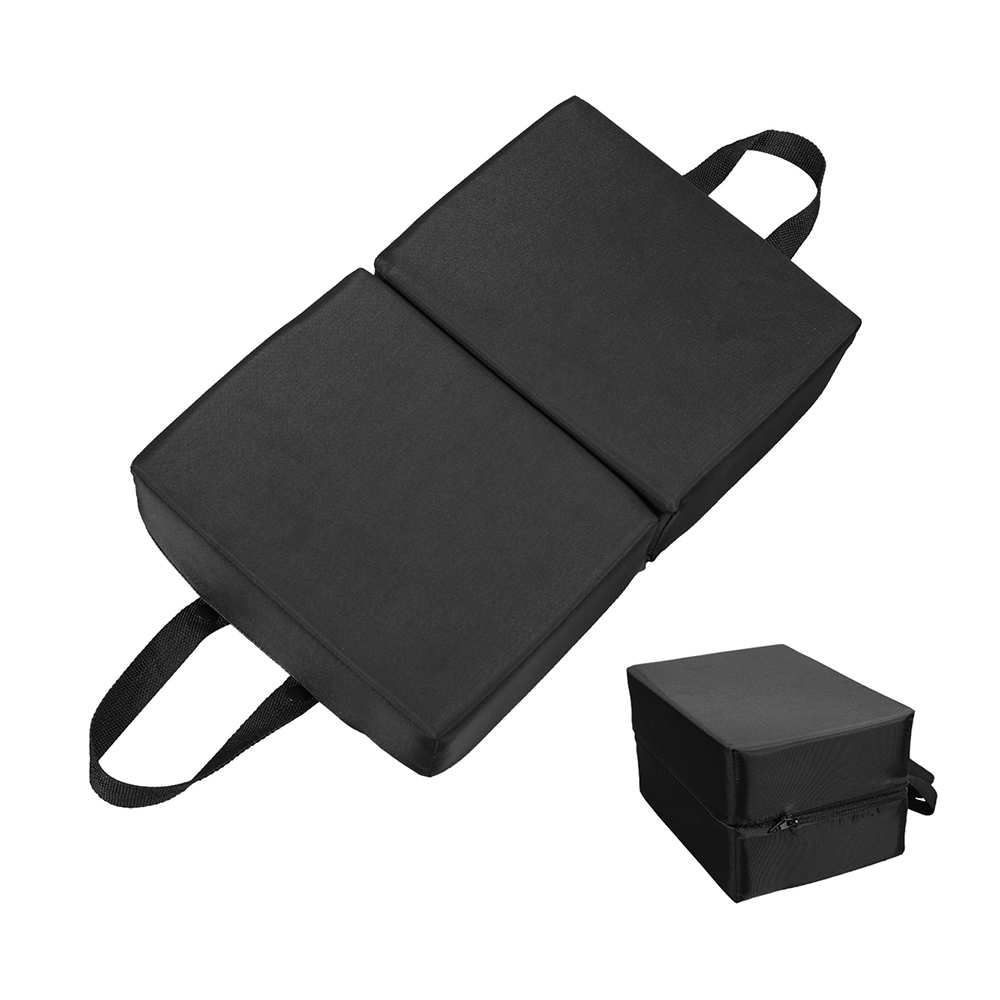
For floor-level platforms, guest rooms and small apartments, a folding foam pad can be laid directly on a hard, even surface — no foundation required, and it folds away when the room needs to serve another purpose.
When Your Regular Frame Is the Wrong Frame
A few bases cannot be rescued with a bunkie board and a wrench. If any of the following describes what you own, replace it rather than reinforcing it.
Do not use Warped or cracked side rails; a king frame with no center support; antique or decorative frames rated for display rather than load; any frame that visibly bows when you press the middle with one knee. Foam cannot correct a base that moves.
A Ten-Minute Check Before the Mattress Arrives
Run this sequence before the delivery window, not after. Every step takes a minute or two and none of them requires tools beyond a tape measure.
- Measure the slat gaps at three points on the frame. The widest gap decides the verdict.
- Press the middle of the frame with your knee and watch for movement.
- Confirm the center rail reaches the floor on queen and king sizes.
- Add the mattress weight to the sleepers' weight, then compare the total with the frame rating.
- Lift the mattress after the first 30 nights and check the underside for ridges, damp patches or compression lines.
Quick verdict If the gaps are under 3 inches, the center rail touches the floor and the frame does not flex under your knee, the regular bed frame you already own is fine. Unbox with confidence, then check again after a month.
The Bottom Line
Yes, you can use a memory foam mattress on a regular bed frame, and in most bedrooms you should. No box spring is required. What is required is a flat, closely spaced, rigid support surface and a frame rated for the loaded weight of foam plus sleepers.
The frame is not an accessory to the mattress; it is part of the sleep system. A bunkie board and a center leg will do more for a five-year-old memory foam mattress than any topper, because they remove the two forces that damage foam most: concentrated pressure over gaps and repeated flexing under load.
That is also how we approach the question on the manufacturing side. Foam is engineered to hold a shape under sustained load, and the base underneath determines whether it holds the right one. Since 2003, our plant has developed more than a hundred foam formulations a year — standard, gel-infused, temperature-insensitive and fast-dry — for retailers and brand owners in the United States, Germany and Japan, and the foundation question comes up in nearly every product briefing. If you want to see how the mattresses behind those numbers are put together, the manufacturing overview is a reasonable place to start.
If your frame passes the three checks, stop worrying about it and enjoy the mattress. If it fails, fix the base before blaming the foam — a good memory foam mattress will outlast three frames, provided the first one is right.
PREV:Can You Put a Memory Foam Mattress On a Box Spring? Support Rules Explained
NEXT:Can You Place a Memory Foam Mattress on Bed Slats? Yes, Under These 3 Rules
NEXT:Can You Place a Memory Foam Mattress on Bed Slats? Yes, Under These 3 Rules
Interested in cooperation or have questions?
Related News
WELLCARE was founded in 2003, boasting over a decade of profound and extensive experience.
Quick Links
Product
Media Centre
Contact Information
- [email protected]
- +86-517-84998062
- +86-15152354988
- No. 168 Nenjiang Road, Huaiyin District, Huai'an City, Jiangsu Province, China
Copyright © Jiangsu Wellcare Household Articles Co., LTD. All Rights Reserved.
Custom Memory Gel Mattress Manufacturers
